 Menu
MenuGeneral Jean Baptiste Eblé
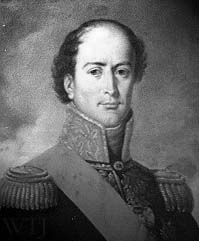
Born: December 21, 1758
Place of Birth: Saint-Jean-Rohrbach, Moselle, France
Died: December 31, 1812
Cause of Death: Fatigues of war
Place of Death: Koenigsberg, Prussia
Arc de Triomphe: ÉBLÉ on the east pillar
Pronunciation:
The son of an artillery sergeant who later became a capitaine, Jean Baptiste Eblé followed in his father's footsteps, joining the artillery in late 1773. Almost twenty years later in May of 1792 he was promoted to capitaine. Captain Eblé served in the 9th Company of Horse Artillery which was attached to the 7th Artillery Regiment, and over the next few years he would serve in the Army of the Ardennes and the Army of the North. 1793 was a big year for Eblé as he was promoted to chef de bataillon in August and then in September he took part in the Battle of Hondschoote . Three weeks later he received a promotion to général de brigade, and not long after that he was designated director of the artillery park of the Army of the North. After fighting at Wattignies in October, Eblé was promoted to général de division and made commander of the artillery of the Army of the North. Over the next year he took part in the sieges of Ypres, Nieuport, Bois-le-Duc, Crèvecoeur, and Nimègue before becoming an inspector general of artillery in late 1794.
General Eblé spent part of 1795 with the Army of Holland and then in April of 1796 he took command of the artillery of the Army of the Rhine and Moselle. That November he served in the defense of Kehl. In late 1798 Championnet gave Eblé command of the artillery of the Army of Rome, and the following January Eblé served at Capua and Naples. In late December of 1799 Eblé took command of the artillery of the Reserve Corps of the Army of the Rhine. Over time he had gained a reputation for tough love, calling his soldiers "my children" but not hesitating to be rough with them if he grew upset with their behavior.1
During the following years, Eblé served on the council of artillery and then commanded artillery troops in Holland and Hanover. He was rewarded for his service as a Grand Officer of the Legion of Honor in June of 1804 and then in August of 1805 he took command of the artillery of Bernadotte's I Corps. After campaigning with the army, Eblé was tasked with arming Mainz and other fortresses on the frontier of the Rhine in 1806. Returning to I Corps for the Prussian campaign, he served at Halle and Lübeck before being made governor of Magdeburg. That year he was also awarded the Grand Cross of the Order of the Lion of Bavaria.
With the foundation of the Kingdom of Westphalia in 1807, Eblé was appointed Minister of War for the new kingdom, a position he would hold from September of 1808 to January of 1810. In the meantime he was made a Baron of the Empire and Grand Commander of the Order of Westphalia. In March of 1810 Eblé returned to France and then he was sent south to take command of the artillery of the Army of Portugal. In this position he served during the sieges of Ciudad Rodrigo and Almeida.
After returning to Paris in 1811, the paperwork was submitted in early 1812 for Eblé to become a Count of the Empire. For the upcoming Russian campaign, he was placed in charge of the bridging train of the Grande Armée. He took part in the combat at Smolensk , and during the retreat from Russia he became a critical factor in the army's survival as his foresight and exertions helped save the army at the Berezina River. Napoleon had ordered Eblé to abandon his bridging equipment, thinking it would be not needed. Eblé disagreed but the Emperor was adamant, so he quietly ignored the orders and ordered his men to save as much of the equipment as they could.2 As General Dombrowski lost control of the vital bridge over the river, and General Corbineau discovered a ford over the river, Eblé's fortuitous disregard of orders gave the army a chance to make use of the ford.
Plunging into the freezing water, Eblé led his pontonniers by personal example and they tirelessly worked on constructing bridges night and day. Two bridges were built, enabling the remnants of the army to continue the retreat. Unfortunately many of the camp followers were exhausted from the retreat and so did not take the available opportunities to cross the bridges. Eblé attempted to convince as many as possible to cross, but eventually was forced to set fire to the bridges he had worked so hard to build so the Russians could not easily pursue the army.3
For his work at the Berezina, Napoleon named Eblé commander-in-chief of the artillery of the Grande Armée and gave Eblé the honor of wearing golden spurs, which became a tradition for pontonnier officers of the French army.4 Eblé's exertions and exposure at the Berezina were too much though, and he fell ill and died at the end of the year. The Emperor, unaware of Eblé's death, appointed him the premier inspector general of artillery in January to further reward him. After Napoleon learned of Eblé's death, he ensured Eblé's wife was made a countess as a tribute to the officer whom he could no longer reward.
Notes
- John R. Elting, Swords Around a Throne: Napoleon's Grande Armée, (USA: Da Capo Press, 1997), 249.
- Ibid., 252.
- David G. Chandler, The Campaigns of Napoleon, (New York: Macmillan Publishing, 1966), 840-842.
- Elting, Swords Around a Throne, 253.
Bibliography
- Chandler, David G. Dictionary of the Napoleonic Wars. New York: Macmillan Publishing, 1979.
- Divry, Arnauld. Les Noms Gravés sur l'Arc de Triomphe. Paris: L'Harmattan, 2017.
- Haythornthwaite, Philip J. Who Was Who in the Napoleonic Wars. London: Arms & Armour, 1998.
- Six, Georges. Dictionnaire Biographique des Généraux & Amiraux Français de la Révolution et de l'Empire (1792-1814). 2 vols. Paris: Gaston Saffroy, 2003.
Updated September 2026
© Nathan D. Jensen