 Menu
MenuGeneral Louis Victorin Cassagne
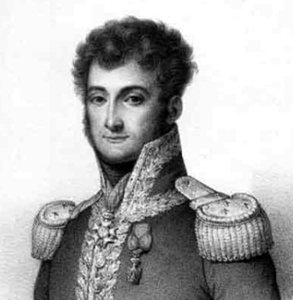
Born: June 5, 1774
Place of Birth: Alan, Haute-Garonne, France
Died: July 6, 1841
Place of Death: Toulouse, France
Arc de Triomphe: CASSAGNE on the south pillar
Pronunciation:
The son of a notary, Louis Victorin Cassagne initially joined the army as a lieutenant in the free company of Haute-Garonne in March of 1793. Only two days later he was promoted to capitaine when his unit was reformed as the 8th Battalion of Volunteers of Haute-Garonne. Sent to the Army of the Eastern Pyrenees, that August he helped to defend the crossing of the Tet River. Seeing action the next year in November of 1794, Cassagne distinguished himself during the fighting at Figuières. After peace was signed with Spain in 1795, Cassagne was transferred to the Army of Italy, where he soon saw action again, being wounded by a shot to the left thigh at Rocca Barbena in November. In March of 1796 his battalion became part of the 69th of the Line, and then later he was sent to the 18th of the Line. That August Cassagne commanded the scouts of the left wing of General Masséna's division and while leading his men he was wounded in the chest near Lake Garda. Cassagne's next action came in January of 1797, when he distinguished himself at La Favorite by forcing an Austrian cavalry commander to put down his weapons and surrender. Cassagne continued to serve on the campaign, receiving another wound in March when he was hit by a shot to the left leg at Tarvis.
Cassagne was next designated for the Army of Orient where he took command of the scouts of General Bon's division. After landing in Egypt, he fought at Chebreiss and then the battle of the Pyramids . Cassagne's next action was fought at the siege of Acre, where he was wounded by two stabs to the left thigh, two to the left arm, and one to the hand. A promotion to chef de bataillon followed in August of 1799. Cassagne remained in Egypt and in 1801 he fought at the battle of Canope where he was wounded by a shot to the right thigh. A few months later he was promoted to chef de brigade of the 25th of the Line before returning to France.
Once back in France, Cassagne was employed in the garrison at Maubeuge until 1804 when he was sent to the camp of Bruges. When the Grande Armée marched to war in 1805, Cassagne served in General Gudin's division in III Corps, and he served in Austria, Prussia, and Poland over the next few years. In particular, Cassagne fought at Auerstädt where he was wounded by a ball to the forehead. After the summer campaign of 1807, he received a promotion to général de brigade.
In late 1807 Cassagne took command of the 2nd Brigade of Vedel's division and then in 1808 he traveled to Spain. He fought at Jaen in July, and then he was present at Bailen for the surrender of the French troops, which he protested against. As a prisoner, Cassagne was put on the ship Minerve and transported to Marseille. Despite being part of the surrender of Bailen, due to his protests against the surrender he did not suffer career setbacks.
General Cassagne was next sent back to Spain where in April of 1809 he joined the 3rd Division of I Corps. That July he fought at Talavera , and then the next year he served in Andalusia, where he commanded the left during the blockade of Cadiz. In 1811 Cassagne fought the guerrillas and was victorious at Medina Sidonia. That year he also took command of the 1st Brigade of Barrois' 2nd Division, he became a Commander of the Legion of Honor, and he again commanded the left during the siege of Cadiz. In late 1811 he served at the siege of Tarifa until the 4th of January, 1812. Cassagne continued to serve in Spain, commanding his brigade in the Army of the South throughout 1812 and that year he also became a Baron of the Empire. In 1813 he was promoted to général de division and he fought at Vitoria in June before being ordered to travel to Mainz.
After arriving at Mainz, Cassagne took command of the 1st Division of Mouton's I Corps, and he served during the defense of Dresden. When Dresden finally surrendered, he was taken prisoner and transported to Hungary. That year Cassagne also received more awards, being named a Knight of the Iron Crown and Commander of the Order of the Reunion. Finally returning to France in June of 1814, Cassagne was rewarded as a Knight of Saint Louis and given command of the department of Haute-Garonne. When Napoleon returned from exile in 1815 for the Hundred Days, Cassagne was employed in the Army of the Eastern Pyrenees. After Napoleon's second abdication, he was put on non-activity.
Bibliography
- Divry, Arnauld. Les Noms Gravés sur l'Arc de Triomphe. Paris: L'Harmattan, 2017.
- Six, Georges. Dictionnaire Biographique des Généraux & Amiraux Français de la Révolution et de l'Empire (1792-1814). 2 vols. Paris: Gaston Saffroy, 2003.
Updated August 2026
© Nathan D. Jensen