 Menu
MenuGeneral Jean Boudet
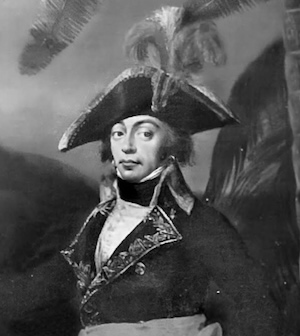
Born: February 9, 1769
Place of Birth: Bordeaux, Gironde, France
Died: September 14, 1809
Cause of Death: Fatigues of war
Place of Death: Budweis, Bohemia
Arc de Triomphe: BOUDET on the east pillar
Pronunciation:
The son of a perfume merchant, Jean Boudet enlisted as a dragoon in the Penthièvre Regiment in 1785. Two years later he was condemned to receive fifty blows by the flat of a saber and remain in the military for four years for not revealing a plot to desert. Nevertheless, despite this punishment, in 1788 he obtained a favor and bought a release from military service. Boudet then returned to his home.
In August of 1792 Boudet answered the call for volunteers and he was elected a lieutenant in the 7th Battalion of Volunteers of Gironde. He served with the Army of the Pyrenees and was promoted to capitaine barely a month later. In 1793 Boudet joined the Army of the Western Pyrenees when the Army of the Pyrenees was split and in June he fought at the defense of Château-Pignon where he was wounded by a shot to the left shoulder. He then went on to serve at the siege of Toulon and at the end of the year he was appointed lieutenant colonel of a battalion of chasseurs. Next Boudet went to the Vendée and then the isle of Ré.
In April of 1794 Boudet left France for Guadeloupe where he seized Fort Fleur d'Epée. That June he was promoted to chef de brigade and named commander of Port de la Liberté. At the end of 1795 Boudet received a promotion to général de brigade and he was placed in charge of the troops in Guadeloupe. He defended Pointe-à-Pitre against the British but had his shoulder hit by grapeshot in the action. Afterwards, General Boudet retook Fort Saint-Charles and seized Sainte-Lucie, Saint-Vincent la Grenade, and Anguilla. In October of 1796 his contributions were recognized with a promotion to général de division.
Boudet remained in Guadeloupe until 1799 when he returned to France for health reasons. That October he was given command of the 3rd Division of the Army of Holland and he served at Castricum before carrying to the Directory the terms of the Convention of Alkmaar. In 1800 Boudet was given command of the 5th Division of the Army of the Reserve. That May he served at the crossing of the Chiusella, Sesia, and Tessin, and he served at the combat of Turbigo. In June he fought at Melegnano, distinguished himself at Lodi, and served at Piacenza. When General Desaix arrived and joined the army, Boudet's division was placed under Desaix's command, and Boudet and his men were part of Desaix's force that saved the day at Marengo. Boudet was wounded at Marengo and afterwards he joined the Army of Italy and served at Monzembano. He next seized the forts of Chiusa and Ala.
General Boudet returned to France in the summer of 1801. That November he was designated to be part of the expedition to Saint-Domingue. Arriving at Saint-Domingue in February, Boudet seized Léogane and Saint-Marc that month. He went on to fight in March at the fort at Crête à Pierrot where he was wounded by a shot to the heel, and then in April he turned over his command and traveled to Guadeloupe. That September Boudet returned briefly to Saint-Domingue before departing for France.
Once back in France, Boudet was sent to Utrecht where he took command of the 1st Division. When the Grande Armée marched to war in 1805, his unit became the 1st Division of General Marmont's II Corps. He took part in the campaign in Austria that year, and after the cessation of hostilities he went into garrison at Trieste. Boudet's next major command came in April of 1807 when he took command of the 1st Division of the Corps of Observation under Marshal Brune. That year he served at the siege of Colberg, seized Trebessèe, and participated in the siege of Stralsund. Afterwards, he was made a Count of the Empire and he went on to command a division on the Rhine.
When Austria again attacked in 1809, Boudet was given command of the 4th Division of Masséna's IV Corps for the Danube campaign. During that campaign, he served at Vienna and then distinguished himself at the battle of Aspern-Essling . Afterwards he was rewarded as a Grand Officer of the Legion of Honor and Knight of the Iron Crown, and he received the Grand Cordon of the Order of the Dannebrog. But Boudet's success was not to last. As Napoleon planned another crossing of the Danube, Boudet was assigned a critical duty of protecting the crossing. On the 6th of July, he lost his artillery to the Austrians and was sharply criticized by Napoleon, perhaps unfairly.
On September 13th, Boudet fell gravely ill. As his condition worsened, he wrote a final letter to his wife and then died the next day. Rumors swirled that he had committed suicide due to Napoleon's reproaches, but no evidence has been found to support that conclusion.1 His daughter later married General Subervie.
Notes
- Monica Fouché, Glory Overshadowed: The Military Career of General Jean Boudet 1769-1809, (Electronic Theses, Treatises, and Disseratations, 2005), 58-59.
Bibliography
- Divry, Arnauld. Les Noms Gravés sur l'Arc de Triomphe. Paris: L'Harmattan, 2017.
- Six, Georges. Dictionnaire Biographique des Généraux & Amiraux Français de la Révolution et de l'Empire (1792-1814). 2 vols. Paris: Gaston Saffroy, 2003.
Updated September 2026
© Nathan D. Jensen