 Menu
MenuGeneral Pierre François Marie Auguste Dejean
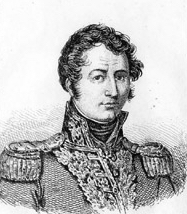
Born: August 10, 1780
Place of Birth: Amiens, Somme, France
Died: March 17, 1845
Place of Death: Paris, France
Arc de Triomphe: DEJEAN, A. on the south pillar
Pronunciation:
The son of engineering officer General Dejean, Pierre François Marie Auguste Dejean first joined the army in March of 1795 as an aide-de-camp to his father. He served in the Army of the Sambre and Meuse and then the Army of the North and in August of 1796 he was commissioned as a sous-lieutenant. Dejean was promoted to lieutenant in August of 1797 and then in 1800 and 1801 he served in the Army of Italy. He received a promotion to capitaine in January of 1801 and then in 1803 he joined the 20th Dragoons. From 1803 to 1805 Dejean served with the Army of the Coasts of the Ocean and when the Grande Armée marched east in 1805 to face the Third Coalition he went on campaign with them. In September of 1805 he was promoted to chef d'escadron. After serving on the campaigns against Austria and then Prussia, in February of 1807 Dejean was promoted to colonel of the 11th Dragoons. He and his men joined Grouchy's division that April.
In 1808 Dejean was named a Baron of the Empire and then he was sent to serve in the Army of Spain. In 1810 he joined the Army of Portugal and then the following year he was promoted to général de brigade and employed in Montbrun's division. At the end of 1811 Dejean was sent to Germany where he took command of a brigade of cuirassiers and in 1812 he led them on the campaign against Russia. After surviving the retreat from Russia, he became an aide-de-camp to Emperor Napoleon and served on the campaigns in Saxony of 1813. In August of that year Dejean took command of the 1st Brigade of the Guards of Honor and then that December he was sent to command Huningue to organize its defense. For the defense of France of 1814, Dejean first organized the levée en masse in Lorraine and then the department of Meurthe before rejoining the army in Champagne. He served at the Battle of Montereau in February and then in March he was promoted to général de division. Dejean was next sent to Paris with Joseph Bonaparte to defend the city, but he could not prevent Marshal Marmont's defection and the surrender of the city.
After Napoleon's abdication in April of 1814, Dejean was confirmed in his rank as a lieutenant général and rewarded as a Knight of Saint Louis by the restored Bourbons. Nevertheless, when Napoleon returned from exile and resumed power in 1815 without a shot being fired, Dejean rallied to him and was appointed an aide-de-camp to Napoleon again. He served at the Battle of Ligny and then after Napoleon's second abdication Dejean was included in the ordonnance of July 24, 1815 that proscribed certain individuals who had supported Napoleon. Forced to leave France, Dejean traveled to Styria, Croatia, and Dalmatia. He was authorized to return to France in 1818 and during the 1820s he published a number of books about beetles. After his father died in 1824, Dejean served in his father's seat as a Peer of France. In 1830 he resumed his military career by commanding the cavalry division of the Army of Belgium and the following year he commanded the cavalry division of the Army of the North. In 1832 he took part in the expedition to Antwerp and from 1832 to 1843 he served as an inspector general of cavalry of various locations.
Bibliography
- Divry, Arnauld. Les Noms Gravés sur l'Arc de Triomphe. Paris: L'Harmattan, 2017.
- Six, Georges. Dictionnaire Biographique des Généraux & Amiraux Français de la Révolution et de l'Empire (1792-1814). 2 vols. Paris: Gaston Saffroy, 2003.
Related Pages:
Updated July 2026
© Nathan D. Jensen