 Menu
MenuGeneral Louis Jean Baptiste Gouvion
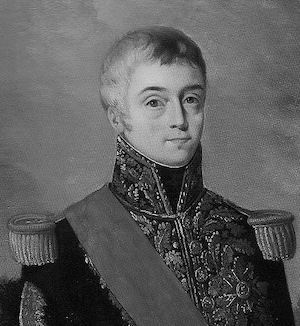
Born: February 6, 1752
Place of Birth: Toul, Meurthe-et-Moselle, France
Died: November 22, 1823
Place of Death: Paris, France
A cousin of General Jean Baptiste Gouvion, Louis Jean Baptiste Gouvion followed in the family trade by joining the army in 1768. In November of that year he was commissioned as a lieutenant in the artillery regiment of Grenoble. In the 1780s Gouvion was promoted to capitaine. After the onset of the French Revolution, in May of 1791 Gouvion became a Knight of Saint Louis and then that October he became a lieutenant colonel commanding the 3rd Battalion of Volunteers of Drôme. Gouvion did not see notable action in 1792 though his cousin was killed in battle that June. At the start of 1793 he was appointed a capitaine in the 4th Foot Artillery in the Army of the Alps and in March he received a promotion to chef de bataillon. That June the representatives of the people with the Army of the Alps promoted Gouvion to général de brigade, and the following month he was named commander at Briançon and Fort Tournoux. At the end of the year Gouvion was named commander at Faucigny and Chablais.
During the campaigns of the Army of the Alps of 1794, Gouvion seized Mont-Cenis and Petit-Saint-Bernard. Next he was employed in Pellapra's division and named commander of the valley of Queyras, and later he blew up the fort of Mirabouc and seized the camp of Lachenal. In 1795 Gouvion was named commander of the advance guard of the Army of Italy and he served under General Sérurier. That summer he briefly commanded at San-Bernardo and Toulon before rejoining the Army of Italy as part of Laharpe's division.
At the end of 1795 Gouvion was named commander of the 1st Division covering the coast of the Army of Italy. In June of 1796 he was sent to the Army of the North to command a division, and then in April of 1797 he was sent to the Army of the Sambre and Meuse. Continuing to serve in different armies, in 1798 Gouvion was sent to the Army of the North and then in 1799 he served in the Army of Holland. That year he joined Vandamme's division in September and then he fought at Bergen where General Brune promoted him to général de division on the battlefield. Next Gouvion fought at Alkmaer and Castricum in October.
In 1800 General Gouvion was named commander of the 9th military division at Montpellier. The next year he became an inspector general of the gendarmerie, and then in 1803 he served in western France. Gouvion was honored as a Grand Officer of the Legion of Honor in 1804 and then in 1805 he became a senator. When the Grande Armée marched to war in 1805, Gouvion was given command of a corps of 10,000 men at Poitiers to cover the Bay of Biscay. He remained in this position until November of 1806 when he was called to Berlin. The following month he was named governor of Warsaw and he continued to serve in Poland through 1807. Gouvion was named a Count of the Empire in 1808.
In August of 1809 Gouvion took command of a National Guard division in the Army of the North under Marshal Bernadotte. A few months later he took command at Lille until January of 1810 when he returned to the senate. In 1812 Gouvion organized troops at Metz, and then in 1813 he again led a National Guard unit, this time in protecting Toulon from the British. After Napoleon's abdication in 1814, the restored Bourbons named Gouvion a Peer of France. He did not serve during the Hundred Days, and afterwards he voted for deportation at the trial of Marshal Ney.
Bibliography
- Divry, Arnauld. Les Noms Gravés sur l'Arc de Triomphe. Paris: L'Harmattan, 2017.
- Six, Georges. Dictionnaire Biographique des Généraux & Amiraux Français de la Révolution et de l'Empire (1792-1814). 2 vols. Paris: Gaston Saffroy, 2003.
Related Pages:
Updated July 2026
© Nathan D. Jensen