 Menu
MenuGeneral Pierre Jacques Étienne Cambronne
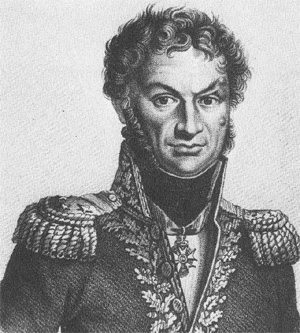
Born: December 26, 1770
Place of Birth: Nantes, Loire-Atlantique, France
Died: January 29, 1842
Place of Death: Nantes, France
Arc de Triomphe: CAMBRONNE on the north pillar
Pronunciation:
The son of a timber merchant, after the arrival of the French Revolution Pierre Jacques Étienne Cambronne joined the army as a volunteer in the 1st Battalion of Loire-Inférieure in September of 1791. The following year he transferred to the 1st Battalion of Mayenne-et-Loire and served in the Army of the Ardennes. In 1793 Cambronne joined the Army of the North before serving with the Army of the Coasts of Brest. Serving in the Vendée, that June he saved a caisson that had been abandoned at the affair of Louav and then in September he was promoted to lieutenant. In 1794 Cambronne was accused by an agent of the government of Guérande of having insulted the agent in crude terms and threatening him. Nevertheless Cambronne remained with the army and in October he was promoted to capitaine.
In 1795 Cambronne served in the Army of the Coasts of Cherbourg and then the Army of the West before fighting at Quiberon. The next year he joined the Army of the Coasts of the Ocean, passed to the 46th of the Line, and served on the expedition to Ireland. In 1797 he served in the Army of the Rhine and Moselle. Continuing to serve in a variety of armies, in 1798 Cambronne served in the Army of England and then in 1799 he served with the Army of the Danube and the Army of Switzerland. That September he fought at the Battle of Zürich where two enemy artillery cannons opened fire on him and his battalion. Cambronne immediately led his company in a bayonet charge against the cannons and captured the cannons before they could let loose a second volley. In 1800 Cambronne served in the Army of the Rhine and distinguished himself at the combat of Oberhausen in June. After the death of the legendary La Tour d'Auvergne, the "1st Grenadier of France", Cambronne's comrades proclaimed him the "2nd Grenadier of France", but Cambronne refused the title.
During the years of peace that followed, Cambronne served in garrison at Dunkirk until 1804 when he joined the Army of the Coasts and was named a Knight of the Legion of Honor. When the campaign against the Third Coalition began in 1805, Cambronne was promoted to chef de bataillon in the 88th of the Line and he served in the Grande Armée and fought at Austerlitz. After Prussia declared war in 1806, Cambronne continued to serve in the Grande Armée and he distinguished himself at the Battle of Jena. A few months later he was recognized as an Officer of the Legion of Honor.
In 1808 Cambronne served in Spain and at Saragossa and in 1809 he joined the 1st Tirailleurs-Chasseurs of the Imperial Guard. After Austria attacked in April, Cambronne participated in the campaign that followed and served at Aspern-Essling and Wagram . The next year he returned to Spain with the 1st Voltigeurs of the Guard and was named a Baron of the Empire. In 1811 Cambronne was named colonel-major of the 3rd Voltigeurs of the Guard and in 1812 he led them on the campaign in Russia.
After surviving the retreat from Russia, in 1813 Cambronne continued to serve in the Imperial Guard and in April he was named a Commander of the Legion of Honor. He participated in the campaigns in Saxony that year and served at Lützen, Bautzen, and Dresden. In September Cambronne joined the 2nd Chasseurs à Pied of the Guard and in October he fought at Leipzig and Hanau. One month later Cambronne was promoted to général de brigade commanding the 1st Chasseurs à Pied of the Guard. For the defense of France of 1814, Cambronne served in the Old Guard, commanding the 2nd Brigade of the 1st Division. That February he fought at Bar-sur-Aube where he was wounded by a shot to the thigh, and then in March he fought at Craonne where he was wounded multiple times. Continuing to fight despite his wounds, at the end of March Cambronne served at the defense of Paris where he was again wounded.
When Napoleon abdicated from the throne in 1814, Cambronne took command of the guard battalion that followed Napoleon into exile on Elba. In 1815 he returned with Napoleon and the battalion to France to reclaim the throne for the Hundred Days. Napoleon rewarded Cambronne by naming him a Grand Officer of the Legion of Honor and promoting him to lieutenant général, but Cambronne refused the promotion. Cambronne was then appointed major-colonel of the 1st Chasseurs à Pied of the Imperial Guard and then further rewarded as a Count of the Empire and a Peer of France.
Taking part in the campaign that June, Cambronne led his men into action at the Battle of Ligny and the Battle of Waterloo. Towards the end of the battle of Waterloo, he was wounded by a shot to the left eyebrow as he stood in the midst of one of his battalion's squares. As the British asked for his surrender, Cambronne replied, "Merde!" which became the known as "le mot de Cambronne", or "the word of Cambronne."1 Some sources have suggested he stated, "The Guard dies but does not surrender", but those words were most likely said by General Michel who did die at Waterloo.
Taken prisoner by the British, Cambronne sent a letter to King Louis XVIII requesting to return to France but he did not receive a response. Instead he was listed in the ordinance of July of 1815 and struck from the army. Nevertheless Cambronne returned to France in December of 1815 where he was promptly arrested and thrown into prison at l'Abbaye. He was tried and condemned to die in absentia, not even allowed to be present at his own trial. However, the lawyer Berryer took up Cambronne's cause and successfully defended him, leading to his acquittal and release in 1816. Cambronne was treated as having retired but without a pension, but in 1818 he was put on non-activity with half pay. In 1820 he was named commander of the 1st subdivision of the 16th military division at Lille and in 1822 he became a viscount. Cambronne retired from the army in January of 1823.
Notes
Bibliography
- Divry, Arnauld. Les Noms Gravés sur l'Arc de Triomphe. Paris: L'Harmattan, 2017.
- Haythornthwaite, Philip J. Who Was Who in the Napoleonic Wars. London: Arms & Armour, 1998.
- Six, Georges. Dictionnaire Biographique des Généraux & Amiraux Français de la Révolution et de l'Empire (1792-1814). 2 vols. Paris: Gaston Saffroy, 2003.
Updated August 2026
© Nathan D. Jensen