 Menu
General Nicolas Dahlmann
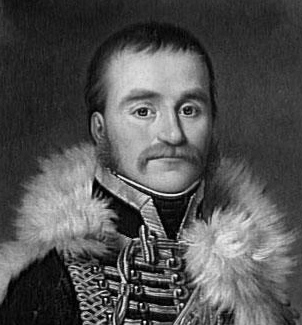
Born: November 7, 1769
Place of Birth: Thionville, Moselle, France
Died: February 10, 1807
Cause of Death: Mortally wounded
Place of Death: Eylau, Prussia
Arc de Triomphe: DAHLMANN on the east pillar
Pronunciation:
The son of a trumpeter in the Dauphin-Cavalerie regiment, Nicolas Dahlmann began his military career as a child of that regiment in 1777. In 1785 he officially joined the regiment but then a few years later in 1790 he left them and later served with the regiment of Alsace. In 1792 Dahlmann served with the Army of the Moselle and then in 1793 he served with the Army of the Eastern Pyrenees and he was wounded by a shot to the right leg at Peyrestortes . After peace was obtained with Spain in 1795, Dahlmann was sent to the Army of Italy. In June of 1796 Dahlmann was incorporated into General Bonaparte's Guides, the unit that protected the commander-in-chief and eventually evolved into the Imperial Guard. In August of 1797 he was commissioned as a sous-lieutenant and then in 1798 he followed Bonaparte on the expedition to Egypt. In Egypt Dahlmann fought at Salahieh that August and he was promoted to lieutenant on the battlefield. The next year he fought at Abukir in July and the following day he was promoted to capitaine. When Napoleon left the army to return to France, Dahlmann went with him as a member of his guard.
Once back in France, Dahlmann and most of his fellow Guides did not return to Paris with their commander, but instead they were to make their way to Paris on their own. Upon arriving at Valence, they were told by the city's administrators that they could not stay. Dahlmann and Bessières, the future Marshal's brother, formed the Guides into battle formation, and aggressively moved into the city. The local guard had no desire to fight them, and upon seeing the Guides moving in battle formation, they disobeyed the city administrators' orders to stop the Guides. The Guides moved into the citadel and made themselves at home.1
As General Bonaparte took power in a coup d'état and became the First Consul, Captain Dahlmann began to serve with the Grenadiers à Cheval of the Consular Guard. In October of 1802 he was promoted to chef d'escadron and he joined the Chasseurs à Cheval, and in 1804 he became an Officer of the Legion of Honor. In 1805 Dahlmann was appointed major in the regiment and he took part in the campaign in Austria. He fought at the battle of Austerlitz and assumed command of the regiment when Colonel Morland was mortally wounded. A few weeks later he was promoted to colonel-major and confirmed as commander of the Chasseurs à Cheval.
In 1806 Dahlmann led his men into action during the campaign against Prussia at the battle of Jena in October and then at Lopaczyn in December. At the end of the year he was promoted to général de brigade and attached to the imperial staff. At the battle of Eylau in February of 1807, as Dahlmann learned that his old unit the Chasseurs à Cheval was going to partake in a cavalry charge, he requested to lead them into battle and the Emperor granted this request. During the charge he was badly wounded by grapeshot to the hip and knocked from his horse. His nephew, who was also a chasseur, managed to get him on a horse and bring him back to friendly lines, but Dahlmann succumbed to his wounds in a few days.2
Notes
- Edward Ryan, Napoleon's Shield and Guardian: The Unconquerable General Daumesnil, (London: Greenhill Books, 2003), 88.
- Ibid., 148-149.
Bibliography
- Divry, Arnauld. Les Noms Gravés sur l'Arc de Triomphe. Paris: L'Harmattan, 2017.
- Six, Georges. Dictionnaire Biographique des Généraux & Amiraux Français de la Révolution et de l'Empire (1792-1814). 2 vols. Paris: Gaston Saffroy, 2003.
External Links:
Updated November 2026
© Nathan D. Jensen