 Menu
MenuGeneral Honoré Vial
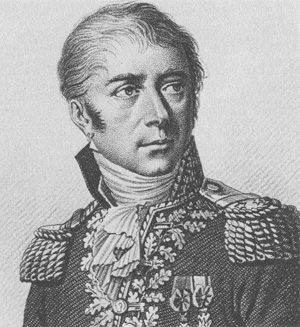
Born: February 22, 1766
Place of Birth: Antibes, Alpes-Maritimes, France
Died: October 18, 1813
Cause of Death: Apoplexy
Place of Death: Leipzig, Germany
Arc de Triomphe: VIAL on the south pillar
Pronunciation:
The son of a merchant, Honoré Vial's military career began when he joined the navy in 1788. Four years later he was a lieutenant in the 26th Infantry and serving in Corsica, helping to defend Bastia and later serving as an aide-de-camp to General Rochon. In June of 1794 Vial became an aide-de-camp to General Delmas in the Army of the North, and in this position he took part in the sieges of Crèvecouer and Bois-le-Duc. That October he was promoted to capitaine and he began serving with the 1st Cavalry.
In December of 1794 Vial was promoted to chef de brigade by a representative of the people with the Army of the North and then in June of 1795 Vial was sent to the Army of the Alps. He later joined the general staff of the Army of Italy. Vial served during the Italian campaign of 1796 and General Bonaparte promoted Vial to général de brigade in August of 1796 and then sent Vial on a mission to Turin. At the Battle of Arcola in November, Vial fought as part of Masséna's division and a few days afterwards he was transferred to Joubert's division. After commanding the light infantry of Joubert's division at the Battle of Rivoli , he went on to occupy Roveredo and Trente and win a battle at Segonzano. In March of 1797 Vial was placed under Baraguey d'Hillier's command and he went on to serve at Tramin and then seize the bridge at Neumarkt. Vial continued to command brigades of light infantry for the rest of his tenure in Italy, but in January of 1798 he was transferred to the Army of England.
The next month Vial was named commander of Rome and a month after that he was designated for the Army of the Orient. Placed under General Menou's command, he fought at Alexandria and then took command of Menou's division for the Battle of the Pyramids . Shortly after the battle, he was ordered to occupy Damietta and he then commanded the provinces of Damietta and Mansourah for the remainder of the year. In January of 1799 Vial joined Bon's division and he served at the Siege of Acre. That April he occupied Sour and fought at Mount Tabor before he returned to Acre to take part in the siege once again.
Finally returning to France in December of 1800, Vial was put on non-activity in September of 1801 but then in May of 1802 he was sent as an envoy to Naples. Promoted to général de division in August of 1803, a few months later Vial replaced General Ney as France's ambassador to Switzerland, a position he would hold for the next five years. He was also named a Commander of the Legion of Honor in June of 1804. In 1809 General Vial was named governor of Venice by Emperor Napoleon's orders. In this position, he helped serve against the insurgents of the Tyrol. Named a Baron of the Empire in 1810, Vial began commanding the 18th military division at Dijon in March of 1811.
In April of 1813 Vial was given command of the 6th Infantry Division. Serving in Saxony, he led his division into battle as part of Marshal Victor's II Corps, fighting at the Battle of Dresden. Two months later Vial was commanding his division at the Battle of Leipzig . Vial was speaking with Marshal Victor when a ball fired by the Russian artillery flew past Victor and then ricocheted, flying directly in front of Vial's face. Vial let out a cry and clutched his chest, falling dead on the spot. Dr. Larrey later examined Vial's body and seeing no wounds and hearing of the manner of his death, suggested that the ball's proximity to Vial's mouth had asphyxiated him.1 More likely Vial died of apoplexy or heart failure, possibly resulting from the stress of the near miss.
Notes
Bibliography
- Divry, Arnauld. Les Noms Gravés sur l'Arc de Triomphe. Paris: L'Harmattan, 2017.
- Chandler, David G. Dictionary of the Napoleonic Wars. New York: Macmillan Publishing, 1979.
- Six, Georges. Dictionnaire Biographique des Généraux & Amiraux Français de la Révolution et de l'Empire (1792-1814). 2 vols. Paris: Gaston Saffroy, 2003.
Related Pages:
Updated June 2026
© Nathan D. Jensen