 Menu
MenuGeneral Pierre Joseph Habert
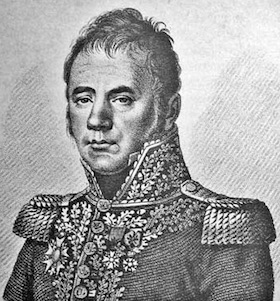
Born: December 22, 1773
Place of Birth: Avallon, Yonne, France
Died: May 19, 1825
Place of Death: Montréal, France
Arc de Triomphe: HABERT on the west pillar
Pronunciation:
The son of a bookseller, Pierre Joseph Habert volunteered to join the 4th Battalion of Yonne in September of 1792 and he was elected a capitaine on the same day. Only two days later he was elected a lieutenant colonel of his battalion. Habert and his men served in the Army of the North for the next four years, notably serving at Ost Capelle in July of 1793. In 1794 Habert was transferred as a chef de bataillon to the 107th demi-brigade of battle and then in November of 1796 he joined the 3rd Regiment of the Foreign Brigade. Habert took part in the first expedition to Ireland in November of 1796, sailing on the ship Eole and returning to France in January of 1797. Over a year later in July of 1798 he took part in the second expedition to Ireland, sailing on the frigate Coquille and then being captured in a naval battle near Ireland.
Habert was finally released and he returned to France in May of 1800. He was initially assigned to the staff of the 17th military division at Paris but then in July he was sent to Egypt to carry dispatches to the general in command there. Habert traveled to Algiers and then to Alexandria where he became an aide-de-camp of General Menou. In March of 1801 he fought at the Battle of Canope and General Menou promoted him to chef de brigade on the battlefield. After the French finally surrendered in Egypt later that year, Habert returned to France.
Back in France, in 1802 Habert took command of the 105th of the Line at Perpignan. The next year he and his men traveled to the camps along the coast where they served until the Grande Armée marched to war in 1805. In August of 1805 Habert's unit was placed with Desjardin's division in Marshal Augereau's VII Corps of the Grande Armée. They served against the Third Coalition during the campaign of 1805, and then against Prussia and Russia in 1806. Habert led his men into action at the Battle of Jena in October of 1806, and then in December he and his men fought at Kolozomb and Golymin . In February of 1807 Habert served at the Battle of Eylau where much of the division was wiped out and afterwards he and his men were assigned to Legrand's division in IV Corps. When the campaign resumed later that year, Habert served at Heilsberg in June where he was wounded by two shots, one to the head and one to the shoulder.
1808 saw Habert receiving a promotion to général de brigade and then taking command of the 1st Brigade of the 1st Division of III Corps in the Army of Spain. That October he served in the attack on Lérin and then the following month he joined Mathieu de Saint Maurice's division and served at Tudela. Next Habert took command of a brigade of Grandjean's division and served at the siege of Saragossa. In April of 1809 he served in Laval's division and then later that year he served at Maria, Belchite, Palengua, and Pons. Continuing to serve in Spain, in April of 1810 Habert took Morella, Grao, and Balaguer and he fought at Lérida. In November he served at Falset before taking part in the siege of Tortosa in December and January. In January of 1811 Habert laid siege to Fort Saint-Philippe of Balaguer and successfully took it, then he went on to seize Cambrils in February. That June Habert received a promotion to général de division and he served at the siege of Tarragona. After the successful conclusion of the siege, he was made a Baron of the Empire and the governor of Tortosa. Habert blockaded Saguntum in September of 1811 and the next month he served at the Battle of Saguntum. At the end of the year he served at the siege of Valencia.
Remaining in Spain, in April of 1813 Habert won at Biar and then fought at Castalla. A few months later he fought the cavalry of the Duke del Parque at Carcaxente and then helped force the British to raise their siege of Tarragona. As the French began to fall back from Spain, Habert took command of Marshal Suchet's rearguard. He served at the combat of Villafranca in September and then became governor of Barcelona in November. Habert was blockaded in Barcelona but managed to hold out, only leaving the city in May of 1814 after Napoleon's abdication was confirmed. In the meantime he had been named a Commander of the Order of the Reunion.
After returning to France, Habert was named a Grand Officer of the Legion of Honor and Knight of Saint Louis by the restored Bourbons. However, he was also put on non-activity. When Napoleon returned from exile in 1815 and resumed power for the Hundred Days, Habert rallied to him and was given command of the 10th Division of Vandamme's III Corps. Serving on the campaign in Belgium that June, Habert distinguished himself at Ligny and then was wounded by a shot to the stomach at Wavre. After Napoleon's second abdication, Habert was again put on non-activity. He retired in December of 1824.
Bibliography
- Divry, Arnauld. Les Noms Gravés sur l'Arc de Triomphe. Paris: L'Harmattan, 2017.
- Six, Georges. Dictionnaire Biographique des Généraux & Amiraux Français de la Révolution et de l'Empire (1792-1814). 2 vols. Paris: Gaston Saffroy, 2003.
Updated July 2026
© Nathan D. Jensen